Next Club Meeting:October 17, 2026,at the Fountaindale Public Library in Bolingbrook from 11:00 am - 5:00 pm
The Animatrix Network is an anime & manga fan club located in the Southwest suburbs of Chicago, Illinois. We usually meet on the third Saturday of each month (except when holidays or conventions coincide). The meetings are free and open to the public. Join us for a day filled with anime.
This site provides news, reviews, commentaries, and previews of the world of anime and everything it inspires in today's pop culture, such as live-action films, comics, music, art, and other weird things to enjoy and contemplate.
"In my last interview with Kim Jung Gi, I tried to figure out who he is, and why he’s so good. In this episode, I’m going to dive deeper. I’m going to analyze his methods, his techniques, and his process… I’m going to figure out HOW he draws. If you’re interested in drawing like Kim Jung Gi, this interview is for you."
Nozomi Entertainment recently made the acquisition news of the year for quite a few people by picking up the long sought after 80's TV classic, Dirty Pair. Often talked about in the same breath among fans of years gone by as Dragon Ball Z, Slam Dunk and Ranma, it's one of the more elusive titles where there has been interest from many over the years in acquiring it but it never came to fruition. With the excitement settling down a touch, we chatted up Nozomi's Shawne Kleckner to get a feel for the title, their plans and the industry in general.
1. Let’s get the important question out of the way; are you a Kei or Yuri fan?
Kei. Love my redheads. :)
2. Nozomi has been all about the fan oriented titles from the start with titles like Aria, Victorian Romance Emma and Super Gals. Out of the titles licensed in the last few years, only The Third really has an action component to it. Dirty Pair stands out a bit because of what it’s about. How do you think it fits in with the library you have?
I think you kind of answered your own question there. When we look at licensing, our first questions are "What are the fans asking for?", followed by "What are they likely to buy?", "Can we get it for them?" and "Would we be proud to release it under the Nozomi label?" The Dirty Pair is one of those classic series that fans have been vocal about wanting for ages. We feel there's a reason for that, and we're excited to be bringing the series to them.
3. Dirty Pair has long been sought after by fans and there have even been public comments from representatives of other companies who have talked about trying to acquire it. Why did it take so long and where there any special hurdles to this?
Without going into specifics, sometimes the negotiations for older series are more difficult -- programs in the vault sometimes have materials issues, the people at the production companies have moved on, rights clearance issues, etc. This show had some issues to overcome so that we could bring it to the fans, and it did take us some time to clear them all. All sorts of things can happen, and you have to be patient and address the quirks of each title as they come to light. It can be frustrating as we certainly want to get programs out to the fans as quick as we can, but sometimes it's a little like being a forensic accountant to connect everything together to get everything completed.
4. The manta among fans is that old titles won’t sell. How has the initial response been to the license acquisition and is there anything you can do to market it more to newer fans who are adverse to older shows?
The fans' response to Dirty Pair has been phenomenally enthusiastic. Actually, our marketing department is already hard at work doing that just that. Kei and Yuri aren't just "girls with guns." They're the *ultimate* "girls with guns," and their story is based on some amazing source material in the form of the novels and short stories. As with our other shows, the strength of the storytelling and characters are what make this title special, and we'll be emphasizing those points to the newer anime fans who already gravitate to our titles.
5. Talking about other shows, Aria has just finished with its final set out. Is there an emptiness inside now that it’s complete?
A little; ARIA's been a great show for us, and we've been working on it for a long time. Having said that, its ending is one of those ones that's just about perfect.
6. Nozomi has a few things on its plate coming up after Rental Magica finishes out in April. Junjou Romantica has a date but what can fans get excited about after that?
As you mentioned, Junjo Romantica is scheduled for May, followed by a thinpak collection for Ninja Nonsense, and the fourth season of Maria Watches Over Us in July, which we just announced, and the first Dirty Pair set and Antique Bakery before the end of 2010. We have a few other things for this fall, but we're not ready to announce them just yet.
7. It’s been a tough couple of years in the anime market. Right Stuf is really the only company that dabbles in multiple sides of the overall anime industry, with licensing, retail and distribution for other companies as well as customer service aspects. How does the market look these days?
Obviously, it's a difficult market right now. Our company is obviously not the biggest out there, and over time we have looked to grow our business by looking to support the industry as a whole through providing services, both to other players but also to the customers through our storefront, catalog, and more.
The business has matured, and as I have said in other interviews, it has never been a better time to be a fan - the breadth of available programs is incredible compared to the old days, and the pricing now is competitive to other entertainment offerings where in the past anime was sold at a premium. Unfortunately, on the business side it's much tougher; the drop off in overall unit sales has a domino effect in terms of difficulties acquiring new licenses, budgeting for features for programs - such as including a dub track - becomes difficult or impossible, and a glut of customer choices for entertainment (feature films, video games on multiple platforms, TV, TV DVD, online legal streaming,etc) causes more competition for each entertainment dollar. And that's not really including the entire economic downturn which has stipped many of these entertainment dollars away from customers in the first place.
Finally, the advent of streaming (both legal and illicit) has changed buying patterns, and there has been a drop off of DVD sales that I think can be attached to that. The industry has to continue to adapt, and in the past virtually all revenue has come from DVD sales. Although streaming has increased in popularity, paid streaming revenue has not come close to the revenue previously received by DVD, so there is not a corresponding replacement of the lost DVD revenue. Unpaid streaming revenue from fansubs removes any income from the publisher or the author, so that is even more damaging.
I think that key will be the presentation of these products in the future - just like TV DVD, we will need to figure out a way to give a value-add to the customer in order to convince them to buy the media versions of the products, whether it be packaging, extras, dubbed versions, or something else, and we need to work with the publishers to get them to understand the importance of these features and the timeliness of the releases here.
The other issue is the fact that there are few national retailers carrying the product, and as unit sales drop, they look to replace this product with something that has higher turns, decreasing the availability of anime at retail. There are many customers that buy only at retail because they are cash customers or individuals who don't have a credit card, do not wish to use one, or don't wish to buy online. I am seeing a return to our industry roots, with more sales to the comic/specialty market than in the past for retail, along with the online sellers of the product through our site and others. Unfortunately, this decreases reach as the traffic in these channels is not the same as the mass market guys. The industry as a whole will have to make significant changes to accommodate this shift in the customer base. The old business models won't support the current marketplace. I do feel that this has also alienated also some, which doesn't help either.
The industry will adapt - but it will be an ongoing process. Anime still remains popular, so it's just a matter of continuing to figure out a way to deliver it profitably to the customer base.
In conjunction with its release on home video this week, Walt Disney Studios Home Entertainment has released the following article and interview with Hayao Miyazaki and John Lasseter about Ponyo. In it, Miyazaki details some of the inspirations for Ponyo, why there is are no computer graphics in the movie at all, his rationale behind the antagonists in his movies, and more.
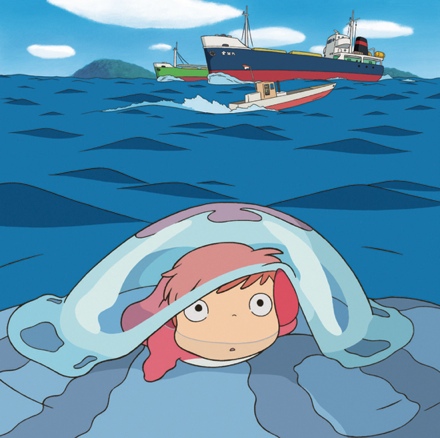
Ponyo, the latest animated masterpiece from Academy-Award-winning director Hayao Miyazaki (Spirited Away) debuts on DVD & Blu-ray on March 2nd from Walt Disney Home Entertainment.
Inspired by Hans Christian Andersen's famous fairy tale, The Little Mermaid, Ponyo tells the enchanting and visually rich story of a young and overeager goldfish named Ponyo and her quest to become human. Ponyo was the top film in Japan in 2008 and is the eighth highest grossing film in Japanese history. Featuring an all-star English language voice cast, including newcomers Noah Cyrus and Frankie Jonas, the Walt Disney Studios presentation of a Studio Ghibli film is also the highest grossing Miyazaki feature in U.S. history.
The single disc Ponyo DVD contains the new English-language version executive produced by John Lasseter, Chief Creative Officer for Walt Disney and Pixar Animation Studios, and Kathleen Kennedy and Frank Marshall. Also included is the subtitled original Japanese version. Bonus features include: "Behind The Microphone," a behind the scenes look at the voice talent for Ponyo, and the music video for the Ponyo theme song sung by Frankie Jonas & Noah Cyrus.
Meanwhile, the single disc Ponyo Blu-ray contains the same content as the DVD, plus such exclusive bonus features as "The Five Geniuses Who Created Ponyo" (including Supervising Animator Katsuya Kondo, Art Director Noboru Yoshida, Color Designer Michiyo Yasuda and Recording & Sound Mixer Shuji Inoue); interviews with Miyazaki and long-time producer Toshio Suzuki; a storyboard documentary; and Trailer #2.
"In one of my favorite scenes, Ponyo arrives at Sosuke's house as a girl while a storm rages," says Lasseter. "Sosuke's mother makes noodles for her -- which she discovers she loves. It's so special, because Ponyo is a little girl but she's a brand-new little girl and everything is brand new to her.
"Ponyo transcends age groups: everybody enjoys this film," adds Lasseter. "I've watched it with many audiences and people are truly entertained by it. There's a depth and a beauty to the film; it really works for all ages."
Aside from The Little Mermaid, what else inspired Ponyo? On a rare trip to Los Angeles for the movie's theatrical release, the legendary director suggested that he was initially attracted to a children's book about a frog: "But as I worked on the story, it became something completely different… so I didn't pursue that direction. I have told the author of that children's book that that was the hint for this film, though. Sometimes, I test myself, wondering, if I get a death sentence if I don't make this movie, would I still make this movie. And that's where the frog came into play."
"He is one of the great filmmakers of our time and has been a tremendous inspiration to our generation of animators," continues Lasseter. "At Pixar, when we have a problem that we can't seem to solve, we often look at one of Miyazaki's films."
The lure of fairy tales still resonates strongly for Miyazaki. "When I work on a new story, I think I'm writing a new story, but when I scrape things away to its core, I realize that there are fragments of these old folk tales or legends that form my stories. It's not that I'm trying to resurrect an old legend, but naturally it's there at the core. I think it shows that I'm in the flow of human civilization."
And what inspiration did Miyazaki glean from the acclaimed Disney animated version of The Little Mermaid? "I watched the video of The Little Mermaid many years ago when I was first given it," Miyazaki continued, "but I haven't watched it recently. And, on purpose, I didn't watch it while making this film."
Not surprisingly, the 68-year-old animation master, who manages to find the time to draw monthly for a Japanese Manga magazine, still maintains the same disciplined approach to making his animated features. "I do all my work on storyboard, so as I draw my storyboard, the world gets more and more complex. And as a result, my north, south, east, west sense of direction kind of shift and go off base. But it seems like my staff as well as the audience don't quite realize that this is happening. Don't tell them about it," he joked.
For those who notice a much simpler graphic design to Ponyo, it's no coincidence. Ponyo marks Miyazaki's return to completely hand-drawn animation. "Actually, at Studio Ghibli, we dissolved the computer graphics section before we started production on Ponyo," Miyazaki explained. "So we had decided at that point to stick with hand-drawn animation… I think I can leave the computer-generated animation to [John Lasseter] and I can stick to the hand-drawn animation."
In fact, watching Ponyo more closely on DVD or Blu-ray will enable the viewer to see how exquisite the splashing waves look. Miyazaki explained that the secret to the hand-animated waves in Ponyo was keeping the squiggly lines moving all the time.
"It reminded me of when I was on holiday at the beach with my boys," explains Lasseter. "The waves were very different—coming up out of the water and smashing right on the boys. They were scared, so I started giving the waves personality—like they're hiding from the kids and waiting for them to come close and then they'd reach up and get them. In Ponyo, Miyazaki actually made the ocean a character," Lasseter continues. "The waves become creatures and the style of the water is actually very believable for the world that he created."
And yet, Miyazaki's appreciation and love of nature is very evident in Ponyo. "It's not that nature or ecology has become a growing concern for me. I think it's just part of our natural surrounding and it's sort of a common thing to depict it. For example, I tell my artists and the team working together to make it smoggier. Then it looks more like the natural surroundings that we live in. It's not that I like smog. So it's the kind of landscape that our children and we are used to living in and whether we should do something about it or not is something that we should think about in real life rather than depicting it in a particular way in the stories on screen."
Even Miyazaki's depiction of villains remains generous in Ponyo. The goldfish's wizard of a father (voiced by Liam Neeson) is terrified that his daughter's transformation into a little human girl will upset the delicate balance of nature. He tries to use his magic to return her to the sea and her former self, rather than letting go and letting her exhibit her free will.
"When I start creating a villain, "Miyazaki explained, "I start liking the villain and so the villain is not really evil. The Fleischer brothers made Superman, and they have a scene where there's a steel making iron works right behind the Hollywood Hills. A bad guy -- the evil character -- who puts so much into creating such a factory and investing so much is somebody that should be lovable. And villains actually work harder than the heroes."
And with Ponyo, the director stresses the importance of family."The most important thing is, I think, that even within such an environment, children grow up, they learn to love and they enjoy living in that environment. I think what is most important is that parents and children see each other as being very valuable and very precious to each other, and if they can get that out of the movie that's fine."
"Ponyo is just stunning visually and tells a wonderful story. The magic in the film, the adventure itself are beyond description," says Lasseter. "It's so beautiful and full of heart and it features great characters. I want people all over the country to see it, fall in love with it, and discover Miyazaki's whole library."
On a rare trip to Los Angeles for the movie's theatrical release, the legendary director spoke about Ponyo:
Q: Aside from The Little Mermaid, what else inspired Ponyo? A: I was initially attracted to a children's book about a frog: But as I worked on the story, it became something completely different… so I didn't pursue that direction. I have told the author of that children's book that that was the hint for this film, though. Sometimes, I test myself, wondering, if I get a death sentence if I don't make this movie, would I still make this movie. And that's where the frog came into play.
Q: Why are you attracted to fairy tales? A: When I work on a new story, I think I'm writing a new story, but when I scrape things away to its core, I realize that there are fragments of these old folk tales or legends that form my stories. It's not that I'm trying to resurrect an old legend, but naturally it's there at the core. I think it shows that I'm in the flow of human civilization.
Q: Did you reference Disney's animated version of The Little Mermaid? A: I watched the video of The Little Mermaid many years ago when I was first given it," Miyazaki continued, "but I haven't watched it recently. And, on purpose, I didn't watch it while making this film.
Q: How do you make your movies? A: I do all my work on storyboard, so as I draw my storyboard, the world gets more and more complex. And as a result, my north, south, east, west sense of direction kind of shift and go off base. But it seems like my staff as well as the audience don't quite realize that this is happening. Don't tell them about it.
Q: Why did you abandon your CG department for Ponyo? A: Actually, at Studio Ghibli, we dissolved the computer graphics section before we started production on Ponyo. So we had decided at that point to stick with hand-drawn animation… I think I can leave the computer-generated animation [John Lasseter] and I can stick to the hand-drawn animation.
Q: How did you achieve the splashing waves? A: The secret was keeping the squiggly lines moving all the time.
Q: Where does your concern for nature come from? A: It's not that nature or ecology has become a growing concern for me. I think it's just part of our natural surrounding and it's sort of a common thing to depict it. For example, I tell my artists and the team working together to make it smoggier. Then it looks more like the natural surroundings that we live in. It's not that I like smog. So it's the kind of landscape that our children and we are used to living in and whether we should do something about it or not is something that we should think about in real life rather than depicting it in a particular way in the stories on screen.
Q: How do you make your villains so sympathetic? A: When I start creating a villain, I start liking the villain and so the villain is not really evil. The Fleischer brothers made Superman, and they have a scene where there's a steel making iron works right behind the Hollywood Hills. A bad guy -- the evil character -- who puts so much into creating such a factory and investing so much is somebody that should be lovable. And villains actually work harder than the heroes.
Q: How is the importance of family demonstrated in Ponyo? A: The most important thing is, I think, that even within such an environment, children grow up, they learn to love and they enjoy living in that environment. I think what is most important is that parents and children see each other as being very valuable and very precious to each other, and if they can get that out of the movie that's fine.